 Skip to content
Running an independent insurance agency today requires balancing client service, sales, carrier relationships, compliance, and operational efficiency, all while navigating an increasingly competitive marketplace. Fortunately, technology has evolved significantly over the past several years, providing agencies with more tools than ever to improve workflows, reduce administrative burdens, and create capacity for growth.
Recent research from McKinsey & Company notes that insurers who successfully adopt AI and digital technologies are gaining a competitive advantage by improving operational efficiency, enhancing customer experiences, and streamlining core business processes. As technology continues to evolve, agencies that combine the right tools with strong operational execution will be best positioned for long-term success.
While every agency’s needs are different, the most successful agencies tend to have one thing in common: they leverage technology strategically to eliminate inefficiencies and allow their teams to focus on high-value activities.
Here are some of the top categories of tools helping independent insurance agencies streamline operations today.
Agency Management Systems
An Agency Management System (AMS) remains the operational backbone of most insurance agencies. Platforms such as AMS360, HawkSoft, Applied Epic, EZLynx, and AgencyZoom help agencies centralize client information, manage policies, track activities, and improve visibility across the organization.
The key to maximizing the value of an AMS isn’t simply having the system, it’s ensuring processes are built around it. Agencies that standardize workflows and consistently document activities often gain the greatest operational efficiencies.
How a VA Can Help: Virtual Assistants can play a critical role in maintaining the integrity of your AMS by updating client records, documenting activities, processing policy changes, managing downloads, and ensuring data remains accurate and current. An AMS is only as valuable as the information inside it, and VAs can help keep that information organized and actionable.
Customer Relationship Management (CRM) Platforms
CRM systems help agencies manage leads, automate follow-up activities, and improve client communication. Tools such as AgencyZoom, Salesforce, and GoHighLevel can help agencies build repeatable sales and service processes while ensuring opportunities don’t fall through the cracks.
When used effectively, CRMs can automate reminders, nurture campaigns, referral requests, and prospect follow-up activities, allowing producers to focus more on selling and relationship-building.
How a VA Can Help: A Virtual Assistant can help keep your CRM running smoothly by entering and updating lead information, monitoring pipelines, assigning tasks, managing follow-up activities, and ensuring opportunities are moving through the sales process. Many agencies find that a dedicated VA helps increase CRM adoption and consistency across the organization.
Automation and Workflow Tools
Many agencies are finding significant efficiency gains through automation platforms. Workflow automation can reduce repetitive administrative tasks such as assigning activities, sending notifications, generating reminders, and managing recurring processes.
Automation doesn’t replace people, it simply helps eliminate manual tasks that consume valuable time. By reducing administrative workload, agencies create more capacity for client service and business development.
How a VA Can Help: While automation can handle routine processes, exceptions and follow-up items still require human attention. VAs can monitor workflows, manage exceptions, verify tasks were completed properly, and ensure automation is working as intended. This “human in the loop” approach helps agencies maximize the benefits of automation without sacrificing quality control.
AI-Powered Tools
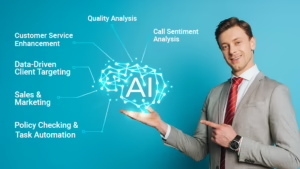
Artificial intelligence is becoming increasingly common within insurance operations. AI tools can assist with:
- Email organization and routing
- Meeting summaries and note-taking
- Content creation
- Data extraction
- Document review
- Customer communication support
While AI can improve efficiency, agencies should view it as a tool that supports employees rather than replaces them. Human oversight remains critical when handling client communications, policy information, and compliance-related activities.
How a VA Can Help: Virtual Assistants can serve as the operational oversight for AI-generated work by reviewing communications before they are sent, validating extracted data, monitoring AI-driven workflows, and ensuring information is accurate and compliant. AI may generate information quickly, but VAs help ensure that information is correct before it impacts a client.
Communication and Collaboration Platforms
With remote and hybrid work environments becoming more common, communication tools have become essential.
Platforms such as Microsoft Teams, Slack, Zoom, and RingCentral help agencies maintain collaboration, improve communication, and keep teams connected regardless of location.
These tools also make it easier to integrate remote support resources into agency operations without disrupting workflows.
How a VA Can Help: Virtual Assistants are often highly integrated into agency communication platforms, allowing them to collaborate in real-time with producers, account managers, and leadership teams. They can monitor shared inboxes, coordinate tasks, manage follow-ups, and help ensure communication remains organized and efficient.
Documentation and SOP Tools
One of the biggest operational challenges agencies face is relying on undocumented processes. Knowledge that exists only in employees’ heads creates risk and limits scalability.
Tools such as Scribe, Loom, Vimeo, and process documentation platforms allow agencies to create Standard Operating Procedures (SOPs) quickly and consistently. Many of these tools can generate training materials while tasks are being completed, significantly reducing the effort required to document workflows.
Well-documented processes improve onboarding, training, delegation, and operational consistency across the organization.
How a VA Can Help: VAs can assist with documenting workflows, recording training videos, updating SOPs, maintaining process libraries, and ensuring procedures remain current as agency operations evolve. In many agencies, VAs become key contributors to process improvement and knowledge management initiatives.
What This Looks Like in Your Agency
Technology can dramatically improve efficiency, but tools are only effective when paired with strong processes and accountability. Many agencies invest in technology but struggle to fully utilize it because their teams remain overwhelmed by day-to-day administrative tasks.
This is where Virtual Assistants can provide significant value. VAs can help maintain CRM data, manage workflows, update systems, assist with documentation, monitor automation exceptions, organize communications, and ensure processes are being followed consistently. In many cases, the combination of technology and dedicated operational support creates far greater results than either one can achieve alone.
Final Thoughts
The insurance industry continues to evolve, and agencies that embrace the right tools will be better positioned to scale, improve client service, and operate more efficiently.
The goal isn’t to implement every new technology that becomes available. Instead, it’s to identify the tools that solve real operational challenges and create a more streamlined experience for both employees and clients.
The agencies that thrive in the years ahead will be those that successfully combine technology, process, and people to build efficient, scalable operations.